
Interactive Toys
CATALOG
Plush Toys That Do Something Back
Adding electronics to a soft toy is not a matter of pushing a module inside it. The moment a toy contains a battery and a circuit, it stops being a textile product and becomes an electrical one, with a different development cycle, different testing, different packaging requirements and a different failure mode. A seam that opens on a teddy bear is a complaint. A seam that opens on a battery compartment is a recall.
We build interactive plush around two capabilities we run as standard: sound modules and motion. Beyond those, other features can be developed on request, and we would rather discuss what you actually need than list capabilities we would have to source in.
Clients here are toy brands, promotional buyers and importers who want a product with more shelf appeal than static plush. The price point sits considerably higher, and so does the barrier to entry, which is precisely why the category is worth being in.
Electronics fitted, not inserted
Modules sit in a dedicated enclosure with the switch placed deliberately, rather than dropped into the stuffing cavity and hoped for.
Battery access designed first
Compartment position, closure type and access method are decided at design stage, because retrofitting a compliant battery door is close to impossible.
Tested before assembly
Electronic components are function tested before they are sewn in. Finding a dead module after the toy is closed means unpicking rather than repairing.
Sound and Motion
Two capabilities we run as standard production rather than as one off projects. Both are shown here on actual samples from our own development.
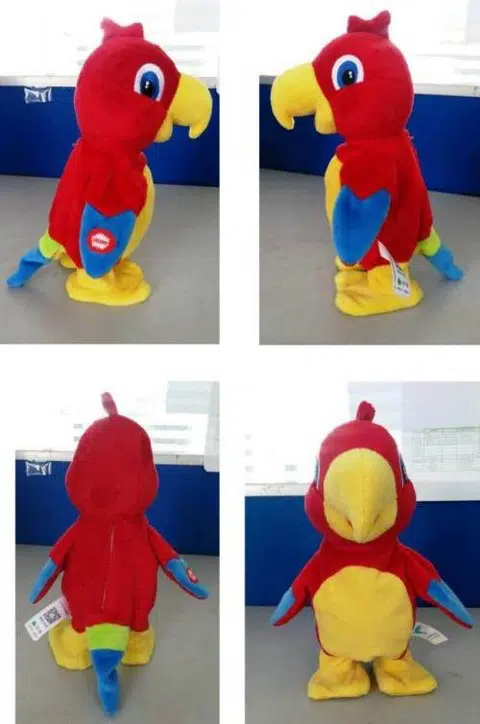
Toys That Speak, Squeak or Play
Push activated sound, repeated phrases and playback modules built into the body cavity. The module is enclosed and the trigger point is chosen so a child finds it without being told.
Every development sample is photographed from four angles like this. Front, side and back all matter on an electronic toy, because the module, the switch and the battery door all have to sit somewhere without spoiling the design.

Toys That Walk and Move
Motorised movement built into the body, with the mechanism balanced so the toy moves properly rather than tipping. Motion is the feature that sells a toy in a shop, because it works from across the aisle.
Note the switch position marked in the photograph. It sits concealed in the back seam, which keeps the front of the toy clean and stops the toy being switched on accidentally in a carton.
Standard Capabilities and Custom Requests
The first two we produce as standard. The rest are developed on request, and we will tell you honestly at inquiry stage what that adds to cost and lead time.
Sound Modules
Push activated phrases, animal sounds, music playback and repeated audio. Sound files are supplied by you or sourced with you, and module capacity determines how much audio the toy can hold.
Motion and Walking
Motorised movement including walking, waddling and body motion. The mechanism has to be balanced against the toy's centre of gravity, which is worked out physically at sample stage.
Recordable Voice
Record and playback so the end user stores their own message. Popular in gift and keepsake products. Available on request.
LED Lighting
Illuminated eyes, glowing bodies and light sequences timed to sound. Adds a compartment and heat consideration. Available on request.
Sensor Activation
Touch, motion or sound triggered response rather than a push button. Changes the play pattern considerably. Available on request.
Combined Features
Sound with motion, or lighting synchronised to audio. Each additional function adds a development round, so tell us the full specification at the start rather than adding later.
Batteries, Compliance and the Things Buyers Miss
Interactive toys carry requirements a plush toy does not, and this is where first time buyers in this category get caught. None of it is difficult, but all of it has to be decided before production rather than after.
| Consideration | Why it matters |
|---|---|
| Battery type | Button cell compartments face stricter closure rules than AA or AAA in major markets. Choosing the battery decides the compartment design |
| Compartment security | Children's products generally require a secured closure that a child cannot open without a tool. This is designed in, not added on |
| Electrical toy standards | Electric toys sold in the EU fall under a separate electrical safety standard in addition to EN71. Your testing lab will confirm what applies |
| Restricted substances | Electronic components bring their own chemical compliance requirements on top of the textile ones |
| Packaging marking | Battery warnings, disposal symbols and age grading all have to appear on the box, not just the toy |
| Washability | A toy containing electronics cannot be machine washed. Care labelling has to say so clearly or you will get returns |
We produce to your specification and can arrange third party laboratory testing to whatever standard your buyer or retailer requires. What we ask is that you tell us the destination market and intended age grading at inquiry stage, because those two answers determine the battery compartment design, and that is the one thing that genuinely cannot be changed late.
How an Interactive Toy Is Developed
Six stages. This category runs longer than plush because the electronics and the textile have to be developed in parallel and then made to fit each other.
Function brief
What should the toy do, and when. Tell us the destination market and age grading here, since both determine the battery and compartment design before anything is drawn.
Module and mechanism selection
Sound module capacity or motion mechanism chosen against the intended body size. A mechanism that suits a 30 cm toy will not balance inside a 15 cm one.
Housing and switch placement
Where the module sits, where the switch goes and how the battery is accessed. Get this wrong and the toy either looks lumpy or switches itself on in transit.
Sample and function test
The sample is delivered within 7 working days once sample and shipping payment is received, with the function working rather than simulated. Test it properly before approving.
Production
Modules are function tested before assembly, and finished units are tested again after closing. Every unit passes a metal detector before packing.
Packing and dispatch
Battery warnings, disposal marking and age grading applied to the packaging. Switches are set to off and, where required, batteries are isolated for shipping.
Interactive Toy Specifications
Standard options for electronic plush production. Anything outside these ranges is usually still possible, so ask rather than assume.
| Item | Options Available |
|---|---|
| Standard functions | Sound modules and motorised motion |
| On request | Recordable voice, LED lighting, sensor activation, combined functions |
| Activation | Push button, concealed switch, or sensor triggered where specified |
| Switch placement | Concealed in a seam or under a flap, positioned to prevent accidental activation |
| Battery | Type selected against destination market rules, with a secured compartment closure |
| Outer fabric | Short pile plush, long pile fur, velboa, minky, and costume fabrics |
| Sample lead time | 7 working days after sample and shipping payment is received |
| Production lead time | Around 30 working days after sample approval and deposit payment |
| Packaging | Printed boxes, battery warnings, disposal marking, age grading, custom carton marking |
| Testing | Third party laboratory testing arranged to your market and retailer requirements |
| Payment terms | T/T only. 30 percent deposit, 70 percent balance before shipment |
Interactive Toy Questions
Questions specific to electronic plush production. For general manufacturing questions, see the FAQ on our homepage.
What interactive features do you produce as standard?
Sound modules and motorised motion. Those two are what we run regularly, which means the development is predictable and the cost is known.
Recordable voice, LED lighting, sensor activation and combined functions can all be developed on request. We would rather say that plainly than list every possible feature and work out afterwards whether we can deliver it on your timeline.
Can I supply my own sound files?
Yes. Send the audio and we load it to the module. Module capacity determines total duration and how many separate clips a toy can hold, so tell us what you want the toy to say before we select the module rather than after.
One point worth checking on your side: if the audio includes music or a voice recording you did not create, make sure you hold the rights to use it commercially. It is your recording going into a product sold at retail.
Why does the battery decision have to be made so early?
Because the battery type determines the compartment design, and the compartment is structural. Button cell compartments face stricter closure requirements in major markets than AA or AAA, and a compliant secured door has to be built into the body rather than added to the outside.
Changing the battery after the sample is approved usually means redesigning the housing, which effectively restarts development. It is the single most expensive late change in this category.
Where do you put the on off switch?
Concealed in a seam or under a flap wherever possible, as shown on the sample in our capability section. Two reasons: it keeps the front of the toy clean, and it stops units switching themselves on inside a carton.
That second point matters commercially. A shipment of toys that arrive with flat batteries because they were pressed against each other for six weeks generates returns that are entirely avoidable at design stage.
Can interactive toys be washed?
Not in a machine. A toy containing a module, wiring and a battery compartment is surface clean only, and the care label has to say so clearly.
If washability is important for your market, one option is a removable module in a sealed pouch so the outer toy can be washed separately. It adds cost and a step for the customer, so it is worth deciding whether your buyers actually want it.
How much longer does development take than plush?
Longer, and the reason is that two things have to be developed in parallel and then made to fit. The textile body and the electronic assembly each work fine alone. Making the mechanism balance inside a soft body that also has to look right is where the time goes.
Motion products in particular need physical iteration, since balance cannot be calculated reliably on a stuffed object. Build that into your schedule rather than discovering it midway.
What certification does an electronic toy need?
More than a plush toy. Alongside the usual toy safety standards, electric toys face additional electrical safety requirements, and battery compartments face their own rules that have tightened in recent years in both the United States and the European Union.
Requirements differ by market and change over time, so we work to whatever your testing laboratory or retailer specifies rather than telling you what applies. Tell us the destination market and age grading at inquiry stage and we will build to it. If you do not yet have a testing partner, we can arrange third party testing.
Can you add electronics to a design I already produce?
Sometimes, and it depends on the body. A toy with enough internal volume in the right place can often take a sound module with modest pattern changes.
Motion is harder. A mechanism needs a rigid mounting point and a balanced body, and most plush toys are designed with neither. Send us the existing toy and we will tell you honestly whether it can be adapted or whether it needs rebuilding.
What is your minimum order quantity?
Higher than for standard plush, because electronic components carry their own minimums from the component supplier on top of our production minimum.
That component minimum is often the binding constraint rather than the sewing. Tell us the function, the size and your target volume and we will confirm the exact figure with your quotation.
Do you work with small brands and first time buyers?
Yes, though we will be straight with you about whether this category suits a first order. Interactive toys carry higher minimums, longer development and more compliance work than plain plush.
If you are testing a market, a static plush version is often the sensible first step, with the electronic version following once the design has proved itself. We would rather suggest that than sell you a difficult first project.
What are your payment terms?
We accept bank transfer (T/T) only, structured as a 30 percent deposit with the 70 percent balance paid before shipment.
EXW, FOB, CIF and DAP pricing are all available, so you can choose whichever incoterm fits how your freight is already organised.
Other Plush Toy Categories
If your project fits one of these more specifically, start there.
Tell Us What the Toy Should Do
Send your design idea, the function you want and the destination market. We reply with a module recommendation, pricing and a lead time that accounts for the extra development this category needs.
Request a Quote